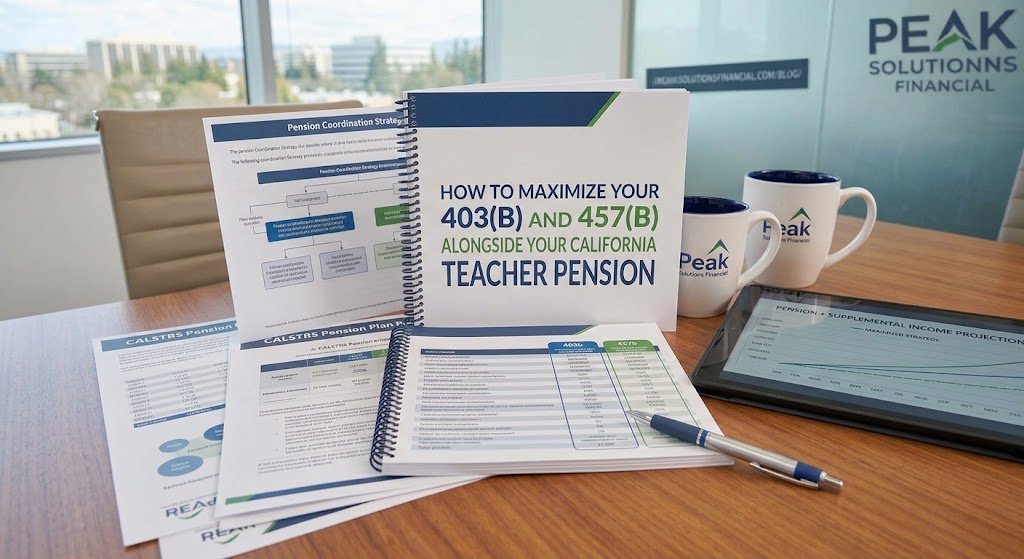
For California public school educators, building a secure retirement relies heavily on a strong financial foundation. While your CalSTRS or CalPERS pension provides a reliable monthly income base, relying on your pension alone may not fully cover your future living expenses, keep pace with inflation, or fund your lifestyle goals in retirement.
That is where supplemental savings accounts—specifically 403(b) and 457(b) plans—become critical tools. When properly coordinated with your state pension, these voluntary retirement accounts allow you to build additional income streams, optimize tax advantages, and fill potential income gaps.
At Peak Solutions Financial, we believe retirement planning works best when every financial element is viewed together. Understanding how your pension, employer-sponsored savings plans, and tax strategies interact is essential for a smooth transition from classroom to retirement.
Why Are the Final Five Years Before Educator Retirement So Important?
Five years may sound like a short period, but there can still be meaningful planning opportunities during this stage.
This is the time to stop looking at your pension, supplemental accounts, savings, and benefits as separate pieces. Instead, we want to see what each source may contribute to your retirement income and what role each source should play.
For example, one source might provide dependable monthly income. Another may be reserved for flexible spending. Another may help cover unexpected expenses. A different account could become important later in retirement.
The goal is coordination.
Our retirement income planning service focuses on bringing retirement income sources into one picture, including pensions, employer-sponsored accounts, IRAs, Roth IRAs, savings, investments, and Social Security when applicable. We pay attention to timing, withdrawal sequencing, taxes, and income continuity.
What Does Diversifying Retirement Income Actually Mean?
Income diversification does not necessarily mean opening more accounts or taking additional investment risk.
For an educator approaching retirement, diversification is better understood as creating a plan that does not depend unnecessarily on one source for every expense.
Your retirement picture might include:
- Monthly pension income
- 403(b) savings
- 457(b) savings, when available
- Traditional IRA savings
- Roth IRA savings
- Personal cash savings
- Social Security benefits, when applicable
- Income available through a spouse or partner
- Other existing retirement assets
Each source works differently.
A pension may provide a dependable foundation, while supplemental savings can provide additional flexibility. Personal savings may be useful for near-term expenses, while other retirement accounts may be planned for later withdrawals.
Instead of asking, “Which account is best?” we prefer asking, “What job should each part of your retirement plan perform?”
How Can Your Pension Become the Foundation of Your Income Plan?
For many California educators, a defined benefit pension is a major part of retirement income.
A defined benefit pension is based on a formula rather than simply on the balance of an individual account. For California educators covered by the state teachers’ retirement system, the retirement benefit formula incorporates service credit, an age factor, and final compensation.
That makes your final working years particularly important.
We encourage educators to review their pension information before making permanent elections. Through our CalSTRS pension review service, we help educators understand benefit projections, service credit history, unused sick leave considerations, payout options, survivor protection, and how supplemental retirement accounts fit alongside pension income.
Your official benefit amount comes from the pension system. Our role is to help you understand the information, compare available choices, and see how your pension connects with the rest of your retirement picture.
How Can a 403(b) Add Flexibility Beyond Your Pension?
A pension and a 403(b) serve different purposes.
For many public educators, the pension may become the income foundation, while the 403(b) serves as a supplemental retirement resource. That supplemental account may help provide flexibility for discretionary spending, larger purchases, unexpected costs, or income needs that your pension does not fully cover.
A 403(b) is a retirement plan available to employees of public schools and certain tax-exempt organizations, and employees may contribute part of their salary to the plan.
During your final five working years, it can be useful to review:
- What you currently have in the account
- How much you are contributing
- How the account fits with your expected pension
- Whether you have older retirement accounts elsewhere
- How withdrawals might eventually fit into your income plan
- Whether your beneficiary information remains current
Our 403(b) retirement planning service focuses on understanding the role of the account within your wider retirement strategy rather than treating the 403(b) as a stand-alone decision.
How Should Other Retirement Accounts Fit Into the Picture?
Educators sometimes reach their final working years with accounts accumulated from different employers or stages of their careers.
You might have a 403(b) from your current school district, a 457(b), an IRA, a Roth IRA, or an account remaining from previous employment.
That does not automatically mean everything should be combined.
Before changing or consolidating accounts, we believe you should understand what you own, how each account works, and what purpose it could serve.
Our employer-sponsored retirement account planning helps organize 401(k), 403(b), 457(b), IRA, and Roth IRA accounts alongside pension income, Social Security when applicable, and savings.
The objective is to replace scattered accounts with a coordinated plan, not simply to move money for the sake of simplifying paperwork.
How Can You Use Each of the Final Five Years More Purposefully?
A five-year timeline can help transform retirement planning from a last-minute event into a deliberate process.
A practical framework may look like this:
Five years before retirement: Gather your pension projections, account statements, savings information, insurance coverage, beneficiary information, and other potential retirement income sources. Begin estimating what retirement may actually cost.
Four years before retirement: Identify potential income gaps. Compare your expected essential expenses with your anticipated dependable income and determine which supplemental accounts may need to support the difference.
Three years before retirement: Review contribution strategies, account organization, protection needs, and potential tax considerations. This is also a useful time to review any older accounts you may have forgotten or left with previous employers.
Two years before retirement: Begin reviewing pension elections more closely. Survivor benefits, payout choices, timing, and household income needs deserve careful attention before paperwork becomes final.
One year before retirement: Turn projections into an actionable income plan. Know where your first year of retirement income is expected to come from, which expenses are covered by dependable income, and which accounts may provide flexibility.
This is not a rigid schedule. Every educator’s circumstances differ. The purpose is to give each remaining year a job instead of trying to make every decision during the final few months.
How Can Tax-Aware Income Planning Improve Coordination?
Different retirement income sources can have different tax treatment, which makes the order and timing of withdrawals an important planning consideration.
Rather than viewing taxes only after income has already been received, we help clients consider how retirement income choices interact before retirement begins.
Our tax-efficient retirement coordination service considers the timing and sequencing of retirement income while coordinating with the licensed tax professional responsible for individual tax advice and filings.
We do not prepare tax returns or provide tax advice. Our role is retirement planning and coordination.
This distinction matters because the goal is not simply to reduce taxes in a single year. Retirement income planning involves understanding how multiple income sources may interact over many years.
How Can Social Security Fit Into an Educator’s Retirement Income?
Social Security will not be identical for every educator.
Your eligibility and benefit amount depend on your individual earnings record and circumstances. For educators who qualify, Social Security may become another component of the retirement income picture rather than something considered separately.
The Social Security Administration provides personalized benefit estimates based on earnings and the age at which benefits begin.
At Peak Solutions Financial, Social Security timing is considered together with other retirement income when it applies. That means looking at the pension, supplemental accounts, household income, and overall retirement needs before evaluating timing decisions.
The important point is to verify your actual situation rather than making assumptions based on what another educator receives.
Why Should Income Diversification Include Protection Planning?
Creating several retirement income sources is only part of the job.
We also need to ask what happens if your household loses one of those sources.
For couples, survivor elections can affect the income available after one spouse dies. Beneficiary designations can determine who receives retirement accounts and other assets. Insurance and protection strategies can help address financial risks that could otherwise disrupt retirement.
Our beneficiary review service helps clients review primary and contingent beneficiaries across retirement accounts, pensions, and applicable policies.
We can also review potential risks through our retirement asset protection planning, which focuses on understanding threats such as unexpected expenses, market risk, long-term care concerns, and outdated protection strategies.
Diversification works better when the entire household plan is protected, not just the primary retiree’s income.
What Mistakes Should Educators Avoid During the Final Five Years?
The final years before retirement can feel busy, which makes shortcuts tempting.
We encourage educators to avoid several common planning mistakes:
- Looking only at the monthly pension estimate
- Treating a 403(b) as completely separate from the pension
- Forgetting about retirement accounts from previous employment
- Making pension elections without reviewing survivor consequences
- Waiting until retirement paperwork is due to start planning
- Assuming another educator’s retirement strategy will work for you
- Ignoring beneficiary designations
- Making withdrawal decisions without considering the tax picture
- Focusing entirely on account balances instead of monthly retirement income
Our dedicated planning guide for public employees and educators brings these pieces together for people whose retirement includes public pension benefits and supplemental accounts.
How Can We Help You Build a More Diversified Retirement Income Plan?
At Peak Solutions Financial, we start by understanding the entire picture.
We look at your income sources, accounts, pension benefits, risks, goals, family considerations, and retirement timeline before recommendations are made.
If you are within five years of educator retirement, this is a valuable time to begin turning separate financial pieces into one coordinated strategy.
We can help you understand:
- Where your expected retirement income may come from
- How your pension fits into that income
- How supplemental retirement accounts can support your goals
- Which income sources may provide flexibility
- How timing and sequencing affect the overall plan
- What pension and survivor decisions deserve attention
- Whether your beneficiaries and protection strategies remain aligned
- Where specialized tax or legal professionals may need to be involved
The goal is not complexity. It is clarity.
When you understand what each income source is designed to do, retirement can become less about wondering whether you have enough separate pieces and more about knowing how those pieces work together.
Which Organizations Support These Retirement Planning Principles?
California State Teachers’ Retirement System. “Retirement Benefits.” CalSTRS. Accessed 24 Aug. 2026.
Internal Revenue Service. “Retirement Plans FAQs Regarding 403(b) Tax-Sheltered Annuity Plans.” Internal Revenue Service. Accessed 24 Aug. 2026.
Social Security Administration. “Get a Benefits Estimate.” Social Security Administration. Accessed 24 Aug. 2026.
What Questions Do Educators Ask About Diversifying Income Before Retirement?Why Supplement Your California Teacher Pension?
Your pension service credit formula determines a large percentage of your retirement income, but it rarely replaces 100% of your pre-retirement earnings—especially if you retire early, take time off during your career, or enter public service later in life. Furthermore, pension cost-of-living adjustments (COLAs) may not keep up with real-world inflation over a 20- to 30-year retirement.
By taking advantage of supplemental retirement accounts early, you gain:
- Income Flexibility: Extra funds for travel, home improvements, or medical costs that exceed your basic pension payout.
- Tax Management: The ability to choose between paying taxes now or deferring them until retirement.
- A Financial Safety Net: Dedicated savings to handle unexpected events without reducing your monthly pension lifestyle.
Our retirement income planning service focuses on evaluating these supplemental options to ensure they work in harmony with your primary pension income.
What Is a 403(b) Plan and How Does It Support Your Pension?
A 403(b) account is a tax-advantaged retirement plan available to employees of public schools and certain tax-exempt organizations. Similar to a 401(k) in the private sector, it allows educators to save money directly from their paychecks into investment options such as annuities or mutual funds.
Key Benefits of a 403(b):
- Automatic Payroll Deductions: Contributions are automatically set aside each pay period, simplifying disciplined saving.
- Higher Contribution Limits: For educators with 15 or more years of service with the same district, special catch-up provisions may allow additional contributions beyond standard IRS limits.
- Compounding Growth: Earnings grow tax-deferred until you start taking withdrawals.
What Is a 457(b) Plan and Why Is It Popular Among Educators?
A 457(b) plan is a deferred compensation plan offered by state and local government employers, including many California school districts. Though less familiar to some teachers than the traditional 403(b), it offers several unique advantages that make it an attractive option for public employees.
Key Benefits of a 457(b):
- No Early Withdrawal Penalty: Unlike a 403(b) or IRA—which typically impose a 10% penalty on withdrawals taken prior to age 59½—you can access your 457(b) funds as soon as you separate from service with your school district, regardless of your age.
- Ideal for Early Retirement: If you plan to retire before age 60, a 457(b) plan can serve as a vital bridge until your full pension benefits begin.
403(b) vs. 457(b): What Are the Key Differences?
Understanding how these two plans compare helps you decide which option—or combination—best serves your long-term goals.
| Feature | 403(b) Plan | 457(b) Deferred Comp |
| Eligibility | Public school & 501(c)(3) staff | State & municipal government employees |
| Penalty-Free Early Access | Generally after age 59½ | Upon separation from employer service |
| Contribution Limits | Subject to IRS elective deferral limits | Subject to separate IRS 457(b) limits |
| Special Catch-Up Rules | 15-year service rule (if eligible) | 3-year prior-to-retirement rule |
Can California Educators Contribute to Both a 403(b) and a 457(b)?
Yes. Because 403(b) and 457(b) plans are governed by separate sections of the tax code, their contribution limits are completely distinct from one another.
If your district offers both plans and your budget permits, you can contribute up to the maximum IRS limit in both accounts simultaneously in the same tax year. This dual-contribution capability allows California educators to save twice as much in tax-advantaged accounts compared to corporate employees with only a 401(k).
Traditional Pre-Tax vs. Roth Contributions: Which Option Fits Your Strategy?
Many district plan providers now offer both Traditional (pre-tax) and Roth (after-tax) contribution options for 403(b) and 457(b) plans.
- Traditional Pre-Tax Contributions: Lower your current taxable income today. You pay federal and state income tax on the distributions when you withdraw funds in retirement.
- Roth After-Tax Contributions: Made using income you have already paid taxes on. Qualified withdrawals in retirement—including all accumulated investment earnings—are 100% tax-free.
Deciding between Traditional and Roth options depends on your current tax bracket compared to where you expect to be during retirement when your pension is active. Coordinating these options with our tax-efficient retirement coordination service helps protect your hard-earned wealth.
How to Sequence Withdrawals in Early Retirement?
When transitioning into retirement, the order in which you draw down accounts matters.
For instance, an educator retiring at age 56 might use a 457(b) plan to bridge income until age 60 or 62, allowing their CalSTRS benefit multiplier to increase while avoiding early withdrawal penalties. Later, 403(b) accounts and IRAs can be accessed to supplement income as needed.
A deliberate withdrawal strategy prevents unnecessary tax spikes and preserves capital over the long run.
What Common Pitfalls Should Educators Avoid When Choosing Supplemental Plans?
- High-Fee Annuity Contracts: Some district 403(b) vendor lists feature equity-indexed or variable annuities with high surrender charges and internal management fees. Review plan options carefully.
- Ignoring the 457(b) Advantage: Many educators default to a 403(b) simply because it is mentioned first during onboarding, missing out on the early-separation benefits of a 457(b).
- Lack of Account Coordination: Managing multiple scattered accounts from former school districts without an overarching asset allocation strategy can diminish net returns.
How Can We Help You Coordinate Your Retirement Savings?
At Peak Solutions Financial, we specialize in helping public employees and educators navigate the complexities of state pensions and employer-sponsored savings plans.
Whether you need a full pension analysis, a complete benefits review, or guidance on optimizing your 403(b) and 457(b) options, our team is dedicated to building personalized strategies for your future.